The History of Division/Clinton

How a 640-acre donation land claim on the edge of pioneer Portland became one of the city's most walkable food-and-drink corridors. It's a story worth knowing,and it starts with a minister from Kentucky.

The Early Days

From a Land Claim to a Neighborhood

This whole corner of Southeast Portland started out as one enormous farm. In the 1840s, Rev. Clinton Kelly,a Methodist minister from Kentucky,crossed the Oregon Trail and settled east of the Willamette River,buying the right to a 640-acre donation land claim for about $50. He cleared land,built a log cabin,and got to work planting a community.

Kelly's name is still all over the east side: Clinton Street, Kelly Butte,and schools and parks that bear his name. The Richmond neighborhood, where much of this corridor sits, is named after his son Richmond Kelly. People like Kelly donated land for schools, churches,and roads, helping turn a river-front farm into a place where his sons,and neighbors could settle.

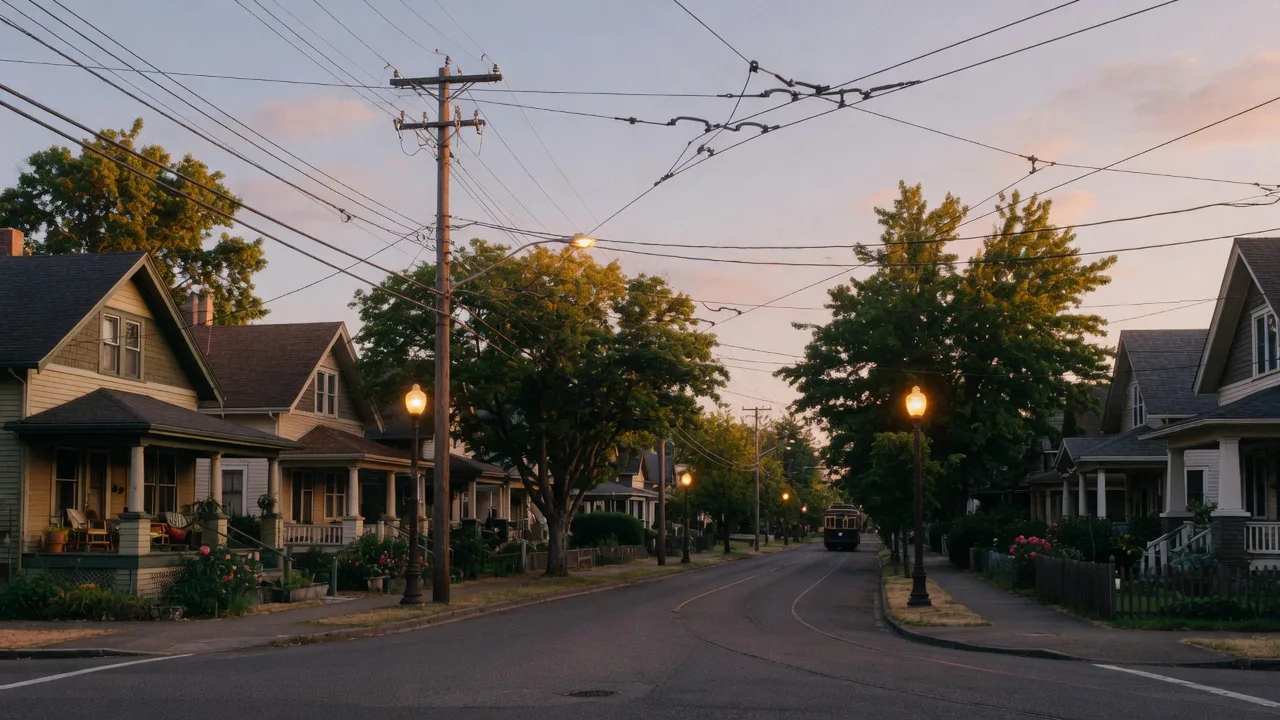
A tree-lined streetcar-era street with Craftsman bungalows in Portland's early 1900s

The Streetcar Era

Streetcars Built This Place

Portland's east side boomed after the Morrison Bridge opened in 1887, giving the east side its first direct link across the Willamette to downtown. Streetcar lines reached the adjoining Sunnyside area by 1888,and within a couple of decades,tracks along Division were selling homes in small subdivisions that popped up one at a time. Today's Richmond contains plats like Windsor Heights,platted in 1909,marketed back then as modern homes a short streetcar ride from downtown.

That era set the neighborhood's character long before anyone coined the phrase "food corridor." Those early 1900s Craftsman bungalows with front porches lining our tree-shaded blocks? Most of our best-loved streets today were built between the 1890s,and the 1920s. And it wasn't just houses: Richmond Elementary School went up in 1908 and stands today as the oldest still-standing school building in the Portland Public Schools district,now home to the district's Japanese Immersion program,which has been going since 1989.

The Commercial Strips

Clinton's Little Main Street

By the 1930s, Clinton Street had become a proper small-town main street. Between roughly SE 20th and SE 26th Avenues,you could find the Clinton Café,a beauty and barber shop,cleaners,a hardware store,a shoe store,and everyday services for families that had settled a block or two away. A few blocks over,Division stayed comparatively sleepy for decades,lined with modest homes anda scattering of corner shops. Back then,it was neighborhood life first,and nightlife much later. The corridor's identity as a place to see and do things would come last,long after the homes.

A Near Miss

The Freeway That Never Came

One of the biggest moments in this neighborhood's history is the thing that didn't happen. In the 1960s,planners drew up an eight-lane freeway that would have peeled off the Marquam Bridge and run east,parallel to Powell Boulevard,in a massive trench roughly 40 feet deep,right about where SE Clinton Street runs today. To build it,the city would have torn out roughly 1,750 long-standing Portland homes,about one percent of the city's housing stock at the time.

Residents fought back. Years of grassroots organizing,joined by new federal environmental laws,slowly wore the project down. Multnomah County pulled its support in 1974,and the Portland City Council voted it dead on July ​25,1974. In part through a federal trade-in program,the freeway dollars became transit dollars,eventually helping fund what became the MAX light rail system. And the homes,the street grid,and the neighborhood itself survived intact,which is the only reason there's a walkable neighborhood here for us to enjoy today.

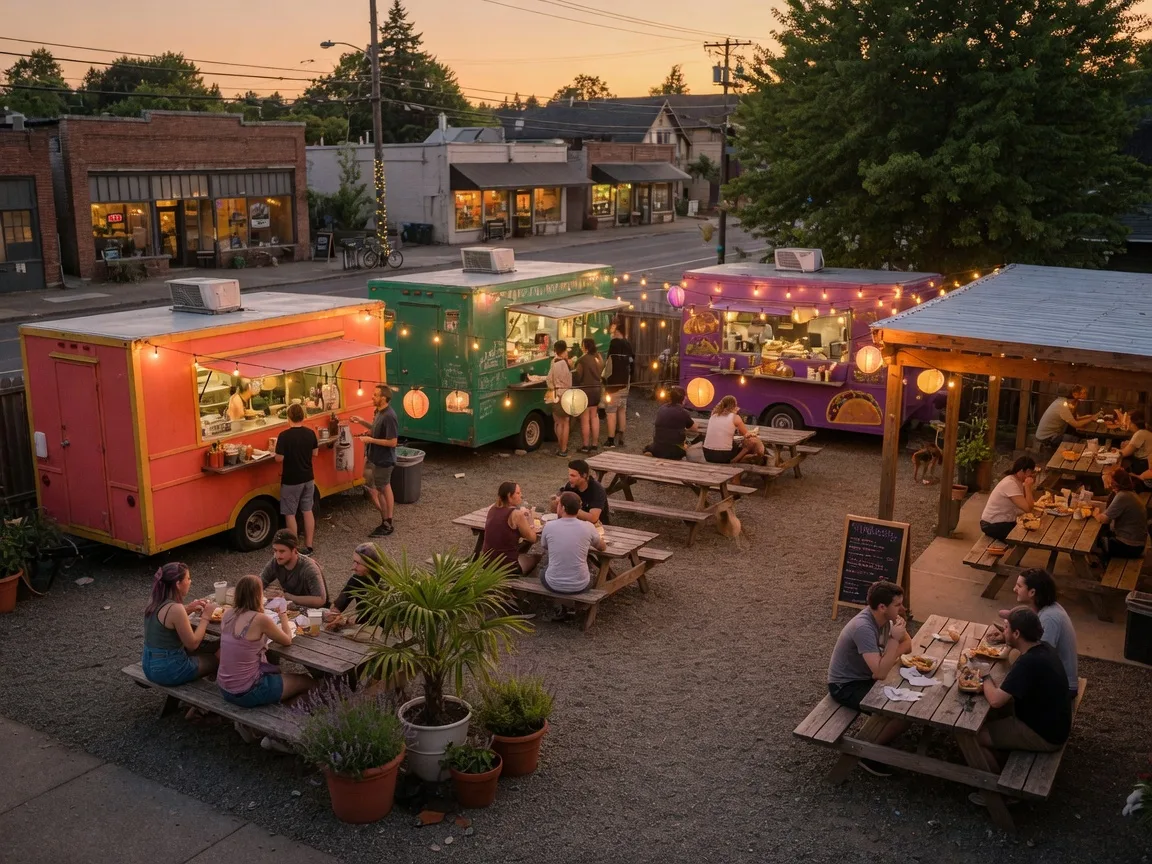
A food cart pod courtyard on a summer evening in the Division/Clinton corridor

The Boom Years

From Sleepy Strip to Food Destination

For a long stretch,Division stayed a quiet commercial street: one observer later described it as a sleepy stretch of adult movie theaters and paint shops by the late 20th century. Cheap rents made it attractive to creatives and food pioneers,though. Stumptown Coffee,founded in 1999,was an early anchor on these blocks.

Then in 2005,chef Andy Ricker opened Pok Pok in a small shack on a quiet stretch of Division,serving Thai food that felt like nothing else in town. The Oregonian would later call its opening the moment "Portland's food scene would never be the same." A wave of acclaimed spots followed through the 2010s: Salt & Straw,Ava Gene's,Olympia Provisions,and plenty more,turning Division and Clinton into the walkable food-and-drink corridor that defines the neighborhood today. Food cart pods that spread across the east side starting in the early 2000s helped fuel it,too,with beloved carts graduating into brick-and-mortar restaurants on these very blocks.

Today you can stroll from a wood-fired pizza spot to a hidden cart pod to a classic cocktail lounge without starting the car. That mix of old bones,and new energy is exactly what makes this corridor special. It took over a century to get here,and that history is all over these blocks if you know where to look.

Places With Stories

Historic Spots Worth Knowing

Some of the best history here is still open for business. Here are a few spots worth walking to.

Clinton Street Theater

Built in 1914,and opened in 1915 as "the Clinton," this single-screen theater is one of the oldest continuously operating movie houses in Portland,and the longest-running single-screen theater in town. It has gone by other names over the decades: the 26th Avenue Theatre from 1945,the Encore from 1969,before the Clinton Street Theater name returned in 1976 when the Clinton Street Collective bought it. Its midnight Rocky Horror Picture Show screenings date back to 1978,and crowds still show up with props in hand.

2522 SE Clinton St

Richmond Elementary School

Built in 1908,this is the oldest school building still standing in the Portland Public Schools district. The neighborhood is named after Richmond Kelly,son of the area's pioneer minister,and the school has served it ever since,including the district's Japanese Immersion program,which began in 1989.

A neighborhood institution since 1908

The Bungalows Themselves

The real landmark here might just be the blocks themselves. A walk around Richmond takes you past Craftsman bungalows built between the 1890s,and the 1920s,the porches that made this one of Portland's classic streetcar suburbs. Many still wear original details: leaded windows,built-in woodwork,corner posts,and wide front steps. Start at the theater,wander north toward Division,and you'll see a century of housing history on nearly every block.

Know Your Neighborhood

Where Exactly Is Richmond?

Here's what we call home. Officially, Richmond is the Southeast Portland neighborhood that runs from SE Hawthorne Boulevard on the north to SE Powell Boulevard on the south, and from SE 29th Avenue on the west to SE 50th Avenue on the east, shifting to SE 52nd Avenue below Division. The Division/Clinton corridor you'll read about on this site runs right through the middle of it, so almost everything we feature is an easy stroll or a short bike ride apart.

The Official Lines

Richmond is a compact, walkable pocket. Once you've driven these four sides once, you'll know exactly where you are:

  • North

    SE Hawthorne Boulevard

  • South

    SE Powell Boulevard

  • West

    SE 29th Avenue, jogs to SE 28th Place between Grant and Division

  • East

    SE 50th Avenue, becomes SE 52nd Avenue south of Division

Our neighbors are Sunnyside to the north, Mt. Tabor and South Tabor to the east, Creston-Kenilworth to the south, and Hosford-Abernethy to the west.

Boundaries per the Richmond Neighborhood Association and the City of Portland.

The Story Is Still Being Written

This neighborhood has spent over a century quietly becoming what it is today,and it's not done yet. The same blocks that sold streetcar suburb homes back in the 1900s are now some of the most sought-after real estate in the city. Want to be part of the next chapter?

Larry